

Why Every Empire Fails, And How to Invest Like the Next Winner Before It’s Too Late
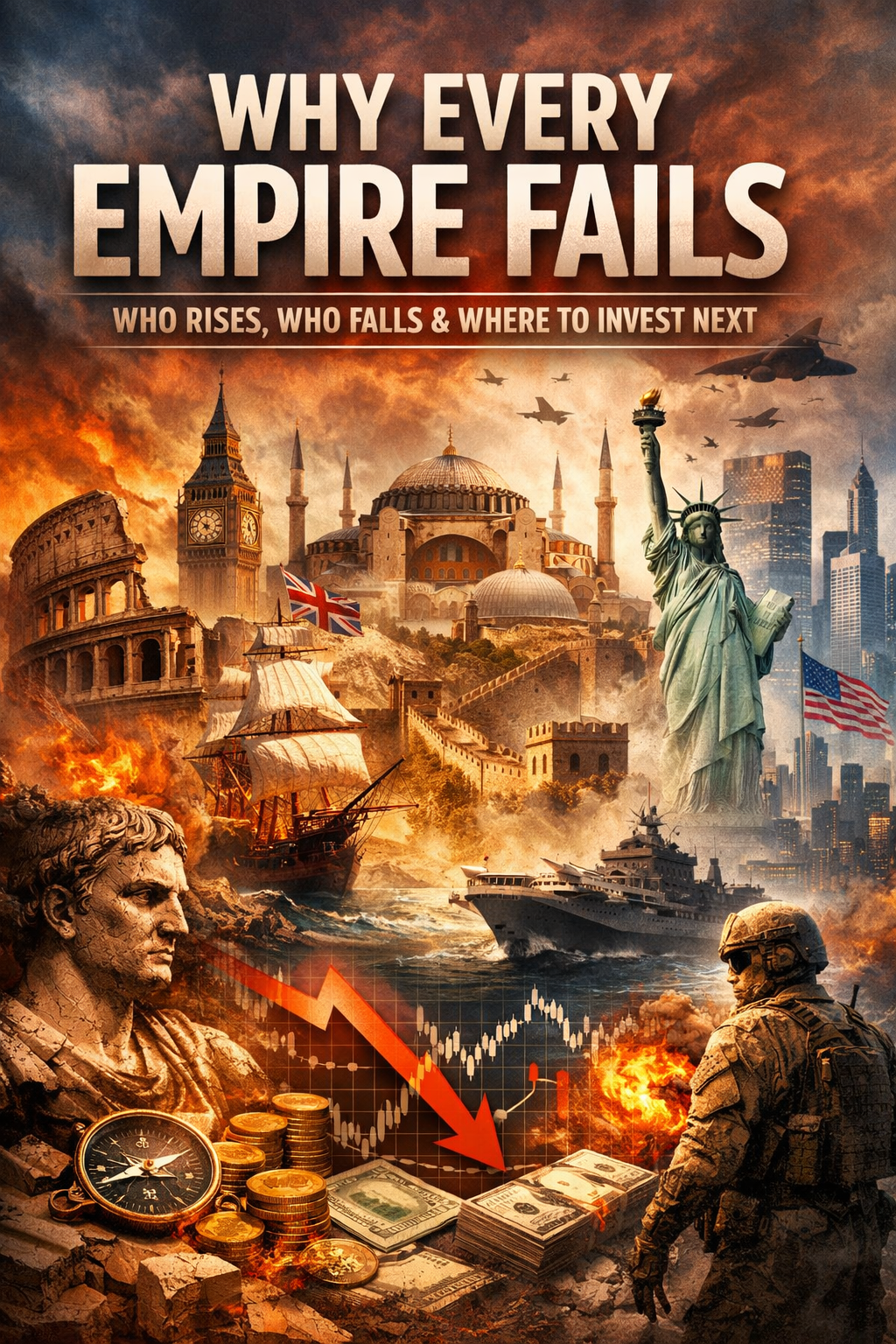
Every Empire Thinks It’s Different
Every Empire Is Wrong.
From Rome to America: The 5 Rules That Decide Who Rises, Who Falls — and Where Your Money Should Go
The most dangerous sentence in history is this:
“This time is different.”
Rome believed it.
Imperial China believed it.
The Ottomans believed it.
The British believed it.
America believes it.
And every time, history answered the same way.
Power is never permanent.
It is rented.
The question is never who is strongest.
The real question is:
Which systems align best with human nature?
Because empires are not built on weapons or borders.
They are built on fear, ambition, belonging, greed, and the need for meaning.
Those forces have not changed since Plato.
They will not change in 2126.
The Pattern Most People Miss
Consider a few civilisations — not as dates in a textbook, but as experiments in organising human behaviour.
The Roman Empire surrounded the Mediterranean Sea. That sea became its internal highway — for trade, grain, taxation and military movement. Rome’s genius was not conquest. It was administration. Law. Roads. Citizenship. It turned power into infrastructure.
Centuries later, in what is now modern Iraq, the Abbasid Caliphate ruled from Baghdad. This period is often called the Islamic Golden Age. Scholars there translated Greek philosophy, developed algebra, advanced medicine, mapped the stars. Trade routes stretched from Spain to India. It was less an empire of territory than of knowledge and commerce.
In East Asia, the Qing dynasty governed what we now call China at its greatest territorial extent. It ruled over hundreds of millions of people through a sophisticated bureaucracy built on competitive civil service exams. For centuries, this administrative machine worked. Until it stopped adapting.
The Ottoman Empire, centred in modern-day Turkey and controlling the vital land bridge between Europe and Asia, lasted over 600 years. It thrived because it sat astride trade routes. It weakened when trade shifted to the oceans and it failed to modernise quickly enough.
Then came the British Empire. An island nation leveraged naval dominance and finance to control a quarter of the globe. It did not just conquer territory. It controlled shipping lanes and capital markets.

Now the United States sits at the centre of global finance and technology. It has two-ocean access, vast farmland, deep capital markets, and after the shale revolution, became one of the world’s largest oil and natural gas producers. LNG terminals originally built to import gas were converted to export it. Geography plus technology multiplied leverage.
Different languages.
Different gods.
Same structure.
What Actually Makes Empires Work
Across 2,000 years, five forces repeat.
1. Control the Flows
Empires don’t just control land.
They control movement.
Grain in Rome.
Silk in Central Asia.
Spices in the Indian Ocean.
Oil in the 20th century.
Data and semiconductors in the 21st.
Whoever controls the critical flow captures disproportionate wealth.
This is why maritime trade eclipsed land empires.
This is why digital infrastructure now rivals oil fields.
Technology changes.
The fight for control does not.
2. Turn Geography Into Advantage
Geography is not destiny. But it is leverage.
Rome had the Mediterranean.
Britain had coal and sea access.
America has two oceans and navigable rivers.
But geography alone is not enough.
Spain had silver from the Americas and still declined.
The Dutch had little land and built the world’s most advanced financial system.

Resources matter.
Institutions matter more.
3. Scale Trust Through Finance
Empires expand when borrowing is cheap.
Borrowing is cheap when trust is high.
Amsterdam pioneered bond markets.
London institutionalised sovereign debt.
New York scaled global capital markets.
Debt does not kill empires.
Loss of confidence does.
History is full of rich empires that decayed once lenders demanded higher returns.
Trust is the invisible asset.
4. Adapt Faster Than Fear
The Qing dynasty governed China effectively for centuries — until industrialisation accelerated elsewhere.
The Ottomans struggled to reform military and administration in time.
Adaptation is not comfort. It is survival.

The next century will test this again:
AI may displace labour.
Demographics will shrink workforces in some nations and expand them in others.
Climate pressures will force infrastructure change.
The winners will not be those with the most tradition.
They will be those who adapt without losing legitimacy.
5. Maintain Belief
This is the multiplier.
Empires endure when people believe:
The system rewards effort.
The future is worth investing in.
Identity aligns with opportunity.
Rome weakened internally before it collapsed externally.
The British Empire faced rising nationalist movements.
Once belief cracks, economics follows.
No spreadsheet predicts that moment.
But history shows it clearly in hindsight.
The Dangerous Assumption
Here is the weak assumption investors often make:
“High growth countries automatically deliver high returns.”
They don’t.
Economic growth and shareholder returns are not the same.
Many fast-growing economies have weak governance or poor investor protections.
Another weak assumption:
“The current leader will remain dominant.”
No empire in recorded history has done so indefinitely.
Dominance fades gradually.
Then suddenly.
What This Means for Investors
The S&P 500 has dominated global returns because America built extraordinary systems: deep capital markets, innovation ecosystems, reserve currency status.
But concentration risk hides during strength.
Diversification across credible, adaptive systems is not pessimism.
It is pattern recognition.
Invest where:
Institutions are strong.
Innovation compounds.
Demographics support demand.
Governance protects capital.
Avoid nostalgia investing.
Avoid headline investing.
Avoid assuming permanence.
Power is rented, not owned.
Empires fall internally before they fall externally.
Control the flows, and you control the future.
Trust compounds — until it doesn’t.
Adaptation beats tradition. Every time.
In 2126, the superpowers will look different.
The technologies will be unrecognisable.
But human nature will be the same.
Ambition.
Fear.
Belonging.
Status.
Survival.
Empires that align with those forces endure.
Empires that fight them fracture.
And investors who understand that difference do not chase headlines.
They follow systems.
History does not repeat.
It tests whether we were paying attention.
The real question is not who rules today.
It is this:
Which systems deserve belief tomorrow?
Because belief — not weapons, not wealth — is what ultimately compounds.
At Money Tipps, we turn financial complexity into clarity. Whether you want to grow your wealth, protect your future, or simply understand how money works, we give you the tools, insights, and strategies to take control.
What we offer:
Expert guidance: Learn from a best-selling author with real-world investing and teaching experience.
Practical tips: Tax, investing, property, pensions, and saving — explained simply and actionably.
Real-world strategies: Clear steps for building diversified portfolios and navigating global markets.
Future-ready thinking: Insights into where growth and opportunity are headed over decades.
Powerful tools: Calculators and guides to optimise income, manage risk, and harness compounding.
Confidence through knowledge: Make smart financial decisions with clarity, not confusion.
Why it matters: Money is more than numbers — it’s freedom, security, and opportunity. We help you act strategically, grow with confidence, and make your money work for you.
In short: Simple. Smart. Future-proof.
Ready to take control of your finances?
Explore https://moneytipps.org/
– Your path to smarter Tax, Investing, Property, Pensions, and Savings.
Neil Doig
Founder of Money Tipps
Educating and Empowering Better Investing
NeilDoig@MoneyTipps.co.uk
www.moneytipps.org
Discover More
Podcast: Millennial Money Mindset
YouTube: Millennial Money Mindset
Check Out My Financial Times Shortlisted Book
Millennial Money Mindset: If You Want The Fruits, You Need The Roots
Copyright © 2026 Money Tipps. All rights reserved.
