

No Shop, No Homes, So Where Did the Money Go? Headington Faces £500k Question

Neil Doig is the Green Party candidate for Headington Ward for the Oxford City
Headington Loses Its Co-op, But Did Residents Also Lose £500,000?
Headington’s high street has lost its supermarket, its Post Office, and a vital community hub.
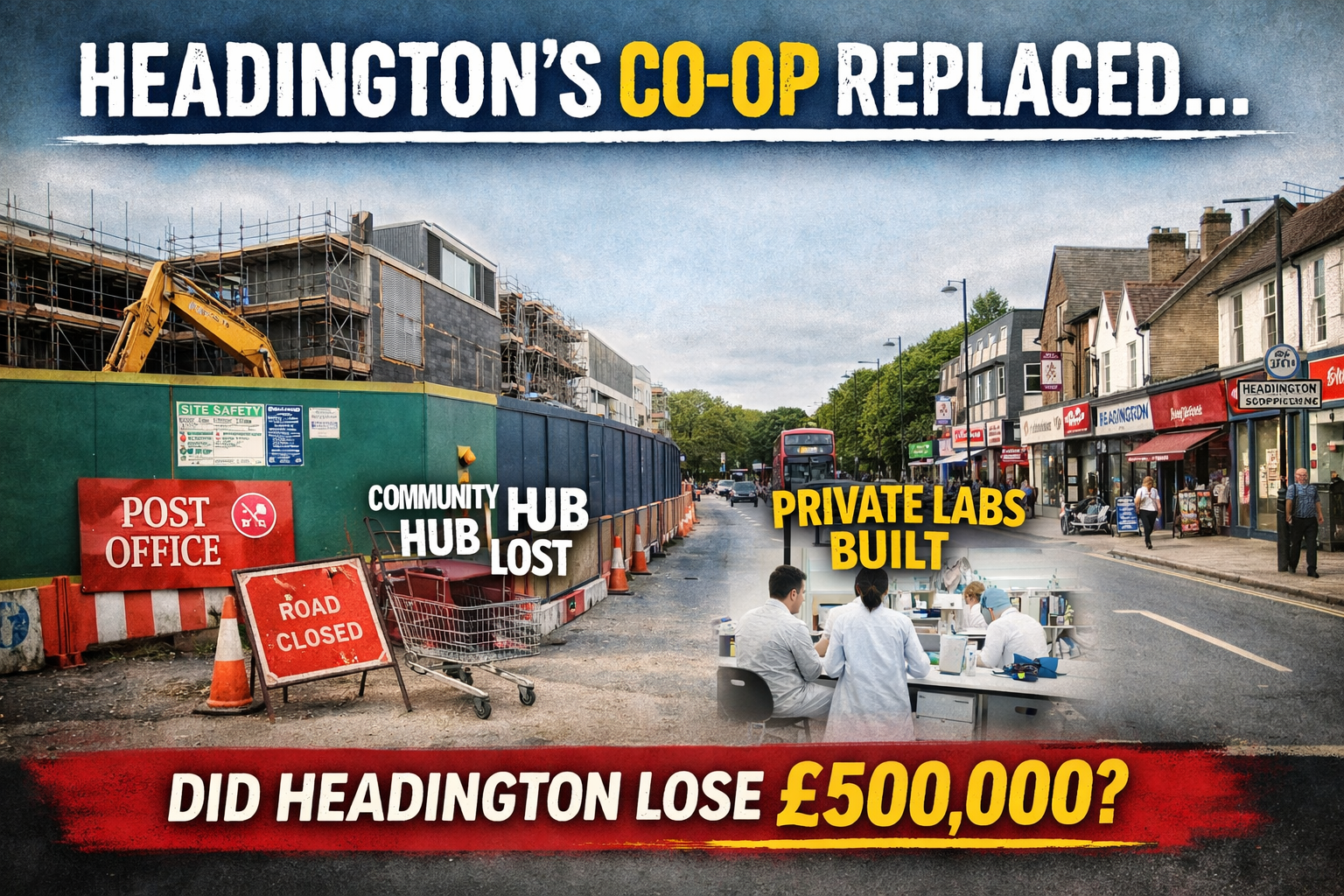
Headington’s High Street has lost a vital community hub.
Headington’s Co-op Site: No Shops. No Homes. So Where’s the Return?
Something important has been lost on London Road in Headington.
Not just a Co-op. Not just a Post Office.
But a piece of everyday infrastructure that made the high street work for the people who live here.
In its place, a new development has been approved: a private research and development building serving Oxford’s growing science economy.
No retail.
No housing.
No obvious public-facing benefit.
That raises a simple, reasonable question:
What did the community gain in return?
🏗️ What Was Approved — Clearly and Factually
Under application 25/00799/FUL, Oxford City Council approved:
A 2–3 storey building with basement
Use Class E(g): research, development, and office space
No requirement for retail provision
No housing component
This is a lawful decision. It sits within planning policy.
But legality is not the same as good outcome.
💰 The Infrastructure Funding Question (What We Know, and What We Don’t)
Modern development is supposed to contribute to local infrastructure through two main routes:
Community Infrastructure Levy (CIL)
Section 106 agreements (S106)
These are not abstract concepts. They are how growth pays for:
GP surgeries
Schools
Transport
Public spaces
Here is the key point:
Different types of development generate very different levels of contribution.
Residential and retail uses typically attract higher CIL rates
Employment uses such as labs and offices often attract lower rates, reflecting policy choices to encourage economic growth
That is not controversial. It is how the system is designed.
⚖️ What Cannot Be Assumed, and Must Be Asked
It would be easy, but wrong, to claim a precise figure for “lost money” without the full data.
Because the final contribution depends on:
The exact floor area
Deductions for existing buildings
The applicable CIL charging zone
Any exemptions or reliefs
So instead of speculation, the responsible question is:
What was actually paid, and how does it compare to realistic alternatives?
That is a question the council can answer.
🏘️ The Bigger Issue Isn’t Just Funding, It’s Land Use
Focusing only on CIL risks misses the deeper point.
The most important decision was not the rate per square metre.
It was this:
Choosing a purely commercial scheme on a brownfield site in a city with a housing crisis.
In Oxford, that choice has consequences:
No homes delivered
No affordable housing contribution
No mixed-use community space
Limited direct benefit to local residents
Once that land-use decision is made, many of the potential community benefits are effectively off the table.
🧭 A Question of Priorities
Oxford is under real pressure:
Rising rents
Key workers priced out
Increasing demand on infrastructure
At the same time, there is strong demand for laboratory and office space.
Both are real needs.
But planning is about balancing competing demands, not simply accepting the most commercially attractive outcome.
🌱 What a Different Approach Could Look Like
This is where the debate becomes constructive.
A different approach would not reject development.
It would ask:
Could this have been mixed-use?
Employment space alongside housing
Could it have included:
Affordable homes
A replacement retail or community unit
Could higher-value elements have helped fund local infrastructure?
These are not radical ideas. They are standard tools in good urban planning.
🔍 The Transparency Test
There is a straightforward way to resolve the current uncertainty.
Publish clearly:
The CIL Liability Notice
Any Section 106 agreement (or confirmation none was required)
The reasoning behind the chosen land use
If the development delivers fair value to the community, that should be easy to demonstrate.
If it does not, then the public deserves an explanation.
🧾 Why This Matters Beyond One Site
This is not just about a single building.
It is about a pattern:
Loss of everyday services
Growth driven by specialist commercial demand
Limited direct return to local communities
Over time, those decisions reshape a place.
The question is whether they do so with the community—or at its expense.
Final Thought
Headington hasn’t just lost a shop.
It may have lost an opportunity:
To provide homes
To retain local services
To secure stronger infrastructure funding
No one is arguing against growth.
But growth should be fair, balanced, and accountable.
And when those principles are in doubt, asking questions isn’t obstruction—
it’s exactly how the planning system is supposed to work.
Neil Doig is the Green Party candidate for Headington Ward for the Oxford City Local Elections on May 7th 2026
No Shops. No Homes. So Where’s the Money? The Question Facing Headington’s Co-op Redevelopment
Residents have lost a supermarket and a Post Office on London Road. In their place comes a private lab development. The issue now isn’t just what’s been lost, but what wasn’t gained. Early estimates suggest the community may have missed out on hundreds of thousands in infrastructure funding. If so, how did that happen, and who signed it off?
This raises wider questions about how planning decisions are assessed and what communities receive in return for major redevelopment.
Neil Doig is the Green Party candidate for Headington Ward. His policy priorities are drawn from the Green Party’s national and local manifesto, including tackling the housing crisis, improving planning accountability, and ensuring new development delivers genuine benefits for local communities in Oxford.
Promoted by David Newman on behalf of Neil Doig, at 12A
Merlin Road, Oxford OX4 6EP.

Neil Doig is the Green Party candidate for Headington Ward for the Oxford City Election on 7th May 2026
